If I Had It to Do Over Again I Would Evangelize Children Moody
| Dwight L. Moody | |
|---|---|
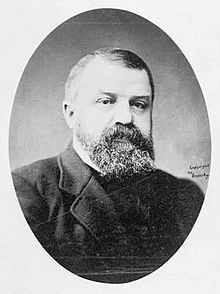 Preacher, evangelist and publisher | |
| Born | Dwight Lyman Moody (1837-02-05)February 5, 1837 Northfield, Massachusetts, U.s.a. |
| Died | Dec 26, 1899(1899-12-26) (aged 62) Northfield, Massachusetts, United states |
| Signature | |
 | |
Dwight Lyman Moody (February five, 1837 – December 26, 1899), besides known equally D. Fifty. Moody, was an American evangelist and publisher connected with Keswickianism, who founded the Moody Church, Northfield School and Mount Hermon School in Massachusetts (now Northfield Mount Hermon School), Moody Bible Found and Moody Publishers.[i] One of his near famous quotes was "Faith makes all things possible... Love makes all things piece of cake." Moody gave up his lucrative boot and shoe business organisation to devote his life to revivalism, working first in the Civil State of war with Union troops through YMCA in the Usa Christian Commission. In Chicago, he built one of the major evangelical centers in the nation, which is all the same agile. Working with singer Ira Sankey, he toured the country and the British Isles, cartoon large crowds with a dynamic speaking manner.
Early life [edit]
Dwight Moody was built-in in Northfield, Massachusetts, every bit the seventh child in a large family unit. His father, Edwin J. Moody (1800–1841), was a small-scale farmer and stonemason. His mother was Betsey Moody (née Holton; 1805–1896). They had five sons and a daughter earlier Dwight's nascency. His male parent died when Dwight was age four; fraternal twins, a boy, and a daughter were born one calendar month after the father's death. Their mother struggled to support the nine children just had to send some off to piece of work for their room and board. Dwight too was sent off, where he received cornmeal, porridge, and milk iii times a day.[2] He complained to his mother, simply when she learned that he was getting all he wanted to eat, she sent him dorsum. During this fourth dimension, she continued to send the children to church. Together with his eight siblings, Dwight was raised in the Unitarian church. His oldest brother ran abroad and was not heard from past the family unit until many years later.[3]
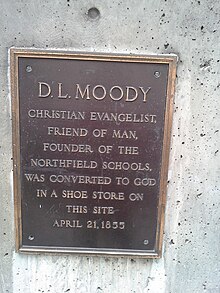
Plaque commemorating the spot on Court Street in Boston where Dwight Moody was converted in 1855
When Moody turned 17, he moved to Boston to work (after receiving many job rejections locally) in an uncle's shoe store. 1 of the uncle'due south requirements was that Moody attend the Congregational Church building of Mount Vernon, where Dr. Edward Norris Kirk served as the pastor. In April 1855 Moody was converted to evangelical Christianity when his Sunday schoolhouse instructor, Edward Kimball, talked to him well-nigh how much God loved him. His conversion sparked the start of his career every bit an evangelist. Moody was non received by the church when he first applied in May 1855. He was not received as a church member until May 4, 1856.
According to Moody's memoir, his instructor, Edward Kimball, said:
I can truly say, and in saying it I magnify the infinite grace of God as bestowed upon him, that I have seen few persons whose minds were spiritually darker than was his when he came into my Dominicus School class; and I think that the committee of the Mount Vernon Church seldom met an applicant for membership more unlikely e'er to become a Christian of articulate and decided views of Gospel truth, still less to make full any extended sphere of public usefulness.[four]
Civil War [edit]

Dwight Lyman Moody c. 1870
The first meeting I always saw him at was in a little onetime shanty that had been abandoned by a saloon-keeper. Mr. Moody had got the place to hold the meetings at night. I went there a little tardily; and the get-go thing I saw was a man standing up with a few tallow candles around him, holding a negro boy, and trying to read to him the story of the Prodigal Son and a great many words he could non readout, and had to skip. I idea, 'If the Lord can ever use such an instrument as that for His honour and glory, information technology will amaze me.' As a event of his tireless labor, within a year the average omnipresence at his school was 650, while 60 volunteers from various churches served every bit teachers. It became and so well known that the only-elected President Lincoln visited and spoke at a Lord's day Schoolhouse meeting on November 25, 1860.[5]
D. L. Moody "could not conscientiously enlist" in the Union Army during the Civil War, later describing himself as "a Quaker" in this respect.[vi] Later on the Civil War started, he became involved with the The states Christian Committee of YMCA. He paid nine visits to the battlefront, being present among the Union soldiers after the Boxing of Shiloh (a.k.a. Pittsburg Landing) and the Battle of Stones River; he besides entered Richmond, Virginia, with the troops of General Grant.
On August 28, 1862, Moody married Emma C. Revell, with whom he had a daughter, Emma Reynolds Moody, and two sons, William Revell Moody and Paul Dwight Moody.
Chicago and the postwar years [edit]

Moody'south first Dominicus school class, North Market Hall, Chicago, 1876
The growing Sunday Schoolhouse congregation needed a permanent home, so Moody started a church in Chicago, the Illinois Street Church.[7]
In June 1871 at an International Sunday School Convention in Indianapolis, Indiana, Dwight Moody met Ira D. Sankey. He was a gospel vocalist, with whom Moody soon began to cooperate and interact.[8] Four months later, in October 1871, the Groovy Chicago Fire destroyed Moody's church building, likewise equally his business firm and those of most of his congregation. Many had to flee the flames, saving just their lives, and catastrophe upwardly completely destitute. Moody, reporting on the disaster, said about his own situation that: "...he saved nothing but his reputation and his Bible."[ix]
In the years after the fire, Moody's wealthy Chicago patron John V. Farwell tried to persuade him to brand his permanent home in the city, offering to build a new house for Moody and his family. Just the newly famous Moody, as well sought by supporters in New York, Philadelphia, and elsewhere, chose a tranquil subcontract he had purchased near his birthplace in Northfield, Massachusetts. He felt he could better recover in a rural setting from his lengthy preaching trips.[2]
Northfield became an important location in evangelical Christian history in the belatedly 19th century as Moody organized summer conferences. These were led and attended past prominent Christian preachers and evangelists from around the world. Western Massachusetts has had a rich evangelical tradition including Jonathan Edwards preaching in colonial Northampton and C.I. Scofield preaching in Northfield. A protégé of Moody founded Moores Corner Church, in Leverett, Massachusetts, and information technology continues to be evangelical.
Moody founded two schools here: Northfield Schoolhouse for Girls, founded in 1879, and the Mount Hermon School for Boys, founded in 1881. In the late 20th century, these merged, forming today'south co-educational, nondenominational Northfield Mountain Hermon School.[ten]
Evangelistic travels [edit]

During a trip to the United kingdom in the spring of 1872, Moody became well known as an evangelist. Literary works published past the Moody Bible Constitute claim that he was the greatest evangelist of the 19th century.[11] He preached nigh a hundred times and came into communion with the Plymouth Brethren. On several occasions, he filled stadia of a chapters of two,000 to four,000. According to his memoir, in the Botanic Gardens Palace, he attracted an audience estimated at between 15,000 and xxx,000.[12]
That turnout connected throughout 1874 and 1875, with crowds of thousands at all of his meetings. During his visit to Scotland, Moody was helped and encouraged by Andrew A. Bonar. The famous London Baptist preacher, Charles Spurgeon, invited him to speak, and he promoted the American besides. When Moody returned to the Usa, he was said to oftentimes attract crowds of 12,000 to twenty,000 were equally mutual as they had been in England.[13] President Grant and some of his cabinet officials attended a Moody meeting on January 19, 1876. He held evangelistic meetings from Boston to New York, throughout New England, and as far westward as San Francisco, besides visiting other Westward Coast towns from Vancouver, British Columbia, Canada to San Diego.[14]
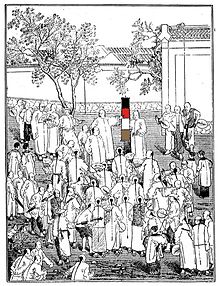
Moody aided the work of cross-cultural evangelism by promoting "The Wordless Volume," a teaching tool developed in 1866 by Charles Spurgeon. In 1875, Moody added a quaternary color to the design of the iii-color evangelistic device: gold — to "represent heaven." This "book" has been and is still used to teach uncounted thousands of illiterate people, young and former, effectually the globe about the gospel bulletin.[15]
Moody visited Britain with Ira D. Sankey, with Moody preaching and Sankey singing at meetings. Together they published books of Christian hymns. In 1883 they visited Edinburgh and raised £10,000 for the building of a new dwelling for the Carrubbers Close Mission. Moody after preached at the laying of the foundation stone for what is now chosen the Carrubbers Christian Centre, ane of the few buildings on the Royal Mile which continues to exist used for its original purpose.[thirteen]
Moody greatly influenced the cause of cross-cultural Christian missions subsequently he met Hudson Taylor, a pioneer missionary to China. He actively supported the People's republic of china Inland Mission and encouraged many of his congregation to volunteer for service overseas.[16]
International acclaim [edit]
His influence was felt among Swedes. Being of English heritage, never visiting Sweden or any other Scandinavian country, and never speaking a give-and-take of Swedish, even so, he became a hero revivalist amid Swedish Mission Friends ( Missionsvänner ) in Sweden and America.[17]
News of Moody's large revival campaigns in Uk from 1873 through 1875 traveled rapidly to Sweden, making "Mr. Moody" a household name in homes of many Mission Friends. Moody's sermons published in Sweden were distributed in books, newspapers, and colporteur tracts, and they led to the spread of Sweden's "Moody fever" from 1875 through 1880.[eighteen]
He preached his last sermon on November 16, 1899, in Kansas Urban center, Missouri. Condign sick, he returned home by train to Northfield. During the preceding several months, friends had observed he had added some xxx pounds (fourteen kg) to his already ample frame. Although his illness was never diagnosed, information technology has been speculated that he suffered from congestive heart failure. He died on December 26, 1899, surrounded by his family. Already installed every bit the leader of his Chicago Bible Institute, R. A. Torrey succeeded Moody every bit its pastor.
Works [edit]
- Sky Diggory Press ISBN 978-1-84685-812-iii
- Prevailing Prayer—What Hinders it? Diggory Printing ISBN 978-1-84685-803-1
- Secret Power Diggory Press ISBN 978-1-84685-802-4
- The X Commandments [nineteen]
- Also, A Life for Christ—What a Normal Christian Life Looks Like.
Legacy [edit]
Religious historian James Findlay says that:
- Speaking before thousands in the dark business conform, bearded, rotund Dwight 50. Moody seemed the prototype of the "businessman in clerical garb" who typified popular religion in late 19th-century America... Earthy, unlettered, a dynamo of energy, the revivalist was very much a human being of his times... Moody adapted revivalism, one of the major institutions of evangelical Protestantism, to the urban context. ... His organizational ability, demonstrated in the great revivals he conducted in England, combined to fashion his spectacular career equally the creator of modern mass revivalism.[20]
X years later Moody'south decease the Chicago Artery Church was renamed the Moody Church building in his honor, and the Chicago Bible Plant has besides renamed the Moody Bible Institute.[21]
During World War 2 the Freedom ship SSDwight 50. Moody was built in Panama Urban center, Florida, and named in his honor.[22]
See also [edit]
- William Phillips Hall, a close friend that was influenced to become an evangelist and lay preacher.
- Horatio Spafford, a friend of Moody who wrote the words to the hymn It Is Well With My Soul
- Northfield Mount Hermon Schoolhouse
References [edit]
- ^ Hayford, Jack W.; Moore, Southward. David (June 27, 2009). The Charismatic Century: The Enduring Impact of the Azusa Street Revival. FaithWords. ISBN978-0-446-56235-5.
Evangelist D.L. Moody was a proponent of the Keswick motility along with others, including Hannah Whitall Smith, whose book A Christian'due south Secret of a Happy Life is still read today by thousands. R.A. Torrey, an acquaintance of Moody whose influence was rapidly increasing, championed Keswick's ideals and utilized the term "Baptism of the Holy Spirit" in reference to the feel.
- ^ a b Johnson, George (2011). What Will A Homo Requite In Substitution For His Soul?. Xlibris Corporation. pp. 113–115. ISBN978-1465380982.
- ^ Johnson, George D. (October 26, 2011). What Volition A Man Give In Exchange For His Soul?. Xlibris Corporation. ISBN9781465380982 – via Google Books.
- ^ Moody (1900), 21
- ^ Johnson, George D. (October 26, 2011). What Will A Man Give In Exchange For His Soul?. Xlibris. ISBN9781465380982 – via Google Books.
- ^ Donald W. Dayton, Discovering an Evangelical Heritage (New York: Harper & Row, 1976), 134.
- ^ Billy Graham Center Archives. "SELECT LIST OF EVENTS FROM MOODY CHURCH HISTORY". Records of The Moody Church building - Collection 330. Wheaton, IL: Wheaton College. Retrieved April 5, 2016.
- ^ OBrien, Glen (June 1, 2015). Christian Worship: A Theological and Historical Introduction. Wipf and Stock Publishers. ISBN9781498231350 – via Google Books.
- ^ Johnson, George D. (October 26, 2011). What Will A Man Requite In Exchange For His Soul?. Xlibris Corporation. ISBN9781465380982 – via Google Books.
- ^ "NMH'south History - Northfield Mount Hermon". Archived from the original on October 9, 2016. Retrieved October 6, 2016.
- ^ Bailey, Organized religion (1987) [1959]. D. 50 Moody. The Moody Bible Institute of Chicago. p. Cover. ISBN0-8024-0039-half-dozen.
- ^ Johnson, George D. (October 26, 2011). What Will A Man Give In Exchange For His Soul?. Xlibris Corporation. p. 115. ISBN9781465380982.
- ^ a b "D.50. Moody -". Worthy Christian Library.
- ^ Moody, William Revell (June 1, 2001). The Life of Dwight L. Moody. The Minerva Grouping, Inc. ISBN9781589632752 – via Google Books.
- ^ Austin (2007), 1-10
- ^ Johnson, George D. (October 26, 2011). What Volition A Man Give In Exchange For His Soul?. Xlibris Corporation. ISBN9781465380982 – via Google Books.
- ^ Gustafson (2008)
- ^ Johnson, George D. (October 26, 2011). What Will A Homo Give In Exchange For His Soul?. Xlibris Corporation. ISBN9781465380982 – via Google Books.
- ^ "THE TEN COMMANDMENTS text past D. Fifty. Moody". Archived from the original on April 9, 2009. Retrieved September xix, 2009.
- ^ James F. Findlay, "Moody, Dwight Lyman," and John A. Garraty, Encyclopedia of American Biography (1974) pp 772-773.
- ^ Timothy J. Demy and Paul R. Shockley (2017). Evangelical America: An Encyclopedia of Gimmicky American Religious Culture. ABC-CLIO. pp. 286–290. ISBN9781610697743.
- ^ Williams, Greg H. (July 25, 2014). The Liberty Ships of World State of war Ii: A Record of the 2,710 Vessels and Their Builders, Operators and Namesakes, with a History of the Jeremiah O'Brien. McFarland. ISBN978-1476617541 . Retrieved December vii, 2017.
Sources [edit]
- "Dwight Moody: evangelist with a common touch" Christianity Today, Baronial 8, 2008.
- Christian Biography Resources
- Dorsett, L. W. A Passion for Souls: The Life of D. 50. Moody. 1997
- Findlay, J. F. Jr. Dwight 50. Moody: American Evangelist 1837–1899. 1969
- Gundry, S. N. Love them in: The Proclamation Theology of D. 50. Moody. 1976
- Evensen, B. J. God's Man for Gilded Age: D. Fifty. Moody and the Rise of Mass Evangelism. 2003
- Gloege, Timothy. Guaranteed Pure: The Moody Bible Plant, Business organisation, and the Making of Mod Evangelicalism (2017)
- Gustafson, David M. "D.L. Moody and the Swedish-American Evangelical Complimentary." Swedish-American Historical Quarterly 55 (2004): 107–135. online
- Hamilton, Michael S. "The Interdenominational Evangelicalism of D.L. Moody and the Problem of Fundamentalism" in Darren Dochuk et al. eds. American Evangelicalism: George Marsden and the State of American Religious History (2014) ch 11.
- Moody, Paul Dwight. The Shorter Life of D. L. Moody. 1900 online
External links [edit]
- Recording of Moody reading the Beatitudes
- Sample sermons by D. L. Moody
- "Shall I enter the Ground forces?" Moody said, "No."
- Works by Dwight L. Moody at Projection Gutenberg
- Works by Dwight Fifty. Moody at LibriVox (public domain audiobooks)

- Works by or near Dwight L. Moody at Internet Archive
- Glad Tidings, sermons past D. Fifty. Moody
- The Gospel Awakening, sermons by D. L. Moody
- books by D. L. Moody
Source: https://en.wikipedia.org/wiki/Dwight_L._Moody
0 Response to "If I Had It to Do Over Again I Would Evangelize Children Moody"
Post a Comment